Salvador Dali was a great admirer of neurologist Freud, and Freudian theories influenced several paintings of Dali. The open drawers can be traced to Freud’s psychoanalytical method and refer to the inner, subconscious within man. Salvador Dali Art For Sale - 645 Listings. Browse Listings Browse Listings. View artworks listed within the last 30 days Favorite Listings.
Salvador Dalí was a multi talented artist. Though known for his surrealist paintings, melting clocks, and eccentric behavior, Dalí was an incredibly skilled and trained craftsman in a multitude of disciplines. His art ranged from the two-dimensional to the three dimensional, from surrealism to realism, from the chaotic to the harmonized. To understand Dalí as an artist one needs to look at his entire canon of work. His skills in sculpture telegraph a different side than his work as a filmmaker. Every way Dalí produced art was a way to tell a different story and different side of himself. Dalí believed that life itself was a work of art, a work of art that needs to be mastered and conquered every day. Thus for Salvador Dalí it made perfect sense for him to turn everything he did into an art form. From the mundane to the extraordinary Dalí saw art blossoming in all things. In fact he developed a skill he called the paranoiac-critical method in order to train his brain to irrationally link objects ideas. He described it as “spontaneous method of irrational knowledge based on the critical and systematic objectivity of the associations and interpretations of delirious phenomena.” With the paranoiac-critical method at his disposal the world was open to Dalí in an endless amount of possibilities. Dalí would forge his inspiration and imagination onto many forms of art and create some of the 20th century’s most memorable artistic icon.
Salvador Dalí’s most famous works are undoubtedly his paintings. Dalí spent many years from a young age being formally trained in traditional painting. He studied the works of the “masters” including, Rembrandt, Velasquez, Vermeer, Raphael, and Da Vinci. It is evident in his earliest of works that Dalí was profoundly influence by realism; he sought to capture the world as it was and to perfect the forms of the world. Soon though his art would take a turn a he would be influenced by the new art movements emerging, Dadaism and Cubism. It wasn’t till his twenties that Dalí fell under the spell of Surrealism and his life changed forever.
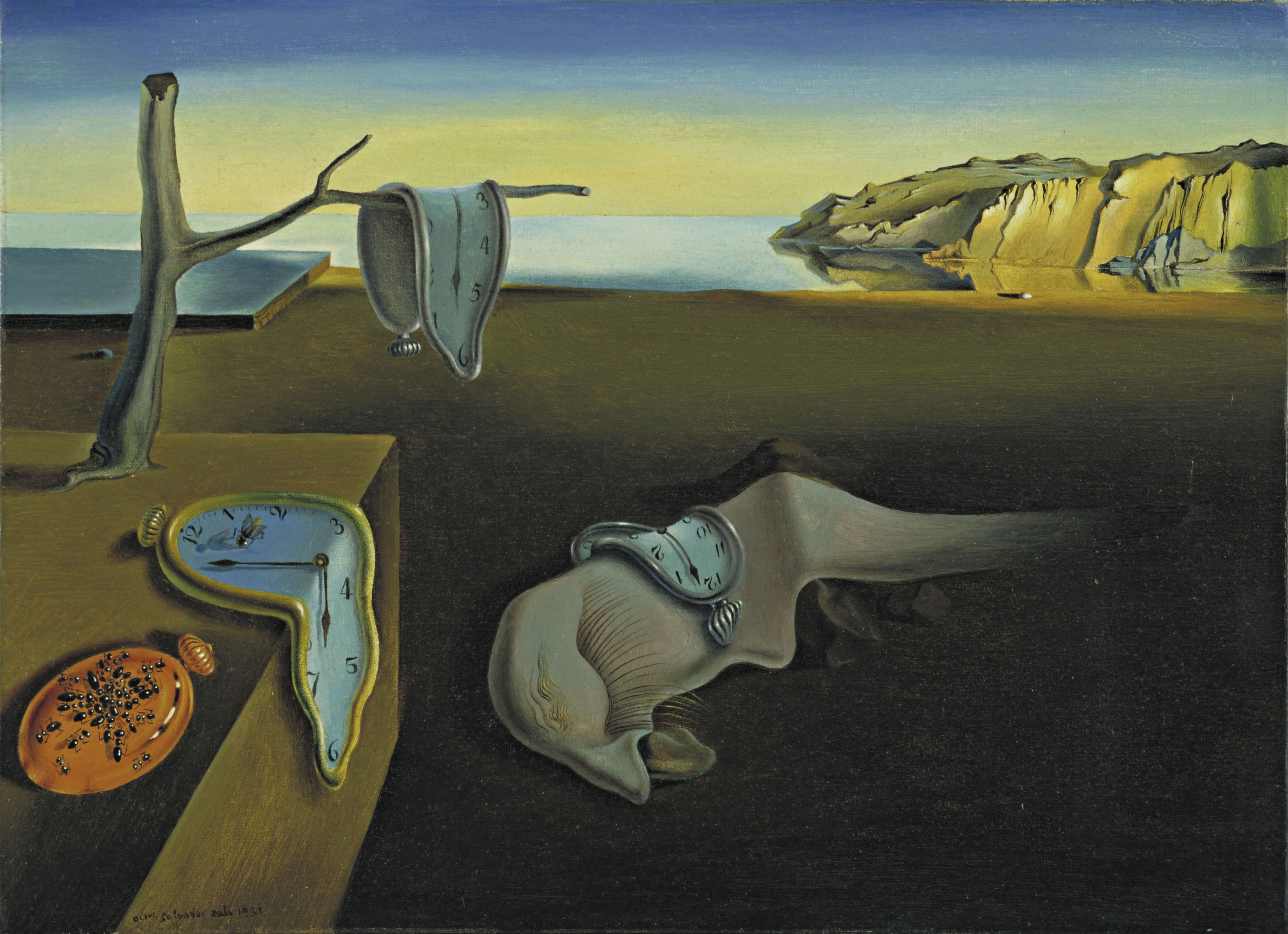
Through all these phases Dalí maintained an impeccable technique. Nowhere is this more evident than in his masterpiece The Persistence of Memory. Here Dalí shocked the world with his unforgettable images of his melting clock.
Throughout Dalí’s paintings you can see a variety of influences. For example a religious influence as seen in his paintings Christ of Saint John of the Cross and Crucifixion (Corppus Hypercubus). You see the influence of Spain in Autumn Cannibalism and Soft Construction with Boiled Beans (Premontion of Civil War). In his paintings Leda Atomica and Galatea of the Spheres we see the influence that science and physics had on Dalí.
Dalí produced approximately 1,700 prints. This limited edition hand signed graphic works ranged in subjects from music like Symphony Bicyclette to plants like the suite FlorDalí. Dalí was a master print maker. He earned the techniques of etching and engraving and regularly worked on this part of his craft to produce brilliant prints. Among his famous prints is his homage to the master, Changes in Great Masterpieces, where Dalí reworks paintings by masters like Vermeer.
Dalí also created an extensive collection of sculptures. Some of the larger ones he has produced have stood around the world in places like London (at the foot of the London eye), Singapore, and all throughout France. Perhaps his most famous sculpture is Lobster Telephone. Dalí worked in this medium during much of his life. It was a way from him to bring his ideas on to the third dimension and give his paintings more life.
Today Dalí’s drawings are highly sought after in the art market. Many of his drawings fetch for thousands of dollars. Usually these drawings were his studies, his initial plans for his works to be. What is remarkable is that these drawings on their own stand as their own legitimate work of art. When you see a Dalí drawing up close you see the extraordinary precision in his artistry.
Salvador Dali Art Pictures
All these manners of expression for Dalí were simply his need to fulfill his life. His paintings hang on the walls of the most prestigious museums in the world; they are often cited for their remarkable vision and talent. His drawings are owned by some of the world’s most prominent art collectors. His sculptures are displayed throughout the world. Dalí’s graphic works are now being bought up by established and new art collectors. These prints were made for the masses and now number in few that are available. They are a way for those who want a piece of Dalí’s legacy.
Dalí was a print maker, painter, filmmaker, photographer, designer, jeweler, sculptor, an artist in every sense of the word….but most importantly, he remains one of the 20th century’s lasting artistic master.
Salvador Dalí will be remembered as one of the greatest artists of the 20th century. His brand of Surrealism combined with his eccentric behavior has guaranteed him a legacy second to none. Though what he might be less remembered for was his brilliant technical mastery of the art of painting. People should not be mistaken; Salvador Dalí was a classic technical master. He was not only one of the 20th century’s greatest artists, but also one of its most refined and accomplished painters. From a young age Dalí was trained in the style of the masters, Vermeer, Rembrandt, and Velazquez. It was in these painters that Dalí shaped himself after. In fact Dalí’s pitchfork mustache was not even his own creation; it was a homage to 17th century Spanish painter Diego Velazquez. It must be understood that Dalí was a painter through and through, everything else came second. In Dalí the world witnessed a rare combination of highly skilled technique and a wildly vivid imagination.
Salvador Dali Artwork
Salvador Dalí the “painter” entered art school at a very young age. During this time he was trained under the supervision of a local Spanish artist, Ramon Pichot. Under Pichot Dalí began to hone his craft and learn the techniques of the Renaissance masters, who Pinchot was very keen on. At this time Dalí was turned on to the works of Impressionist and at one point Dalí himself declared that he wanted to be an Impressionist. It is noted that Mr. Pichot saw in this young Dalí signs of genius and great talent.


By the time Dalí attended the San Fernando Academy of Fine Art he was under the influence of Dadaism and Cubism, precursors to Surrealism. The works that stood out at this time were his paintings, Cabaret Scene (1922) and Composition with Three Figures (1927) were clearly his experimentation with Cubism and Expressionism take hold. Even then, he still remained true to his early ties to technical precession. The Basket of Bread (1926) is a remarkable example of Dalí’s realistic sense and ability. We see here that Dalí is never too far from his realistic roots, even when he was on the verge of going completely Surreal.
Some would argue that Dalí’s first truly Surrealist endeavor was Honey Is Sweeter Than Blood (1927). Somewhere under the influence of Miro and Picasso Dalí produced this work and we see one of his most famous icons, the Dalinian landscape. The Dalinian landscape is a barren plane which will show up repeatedly in Dalí’s paintings. It is around this time that Dalí officially joined the Surrealist movements, and it is around this time that he collaborated with Spanish filmmaker Luis Bunuel to create some of Spain’s classic films; L’Age d’Or and Un Chien Andalou. The two films are like watching Dalí’s paintings come to life.
Soon after Dalí joined the Surrealist movement he created one of his greatest masterpieces, in fact, one of the greatest works of art every, The Persistence of Memory. The story behind this work of art is now talked about like an epic artistic myth. Apparently Dalí wakes from his slumber one day in his studio and sees some melting cheese and connects the transformation of the cheese with the passing of time….and like that, voila…..the iconic melting clocks. The Persistence of Memory sent shock waves throughout the art community. With this work, Dalí not only declared himself a staunch Surrealist, but he also declared himself as one of modern art’s greatest forces. The impact of The Persistence of Memory cannot be overstated; it is a remarkable work which brings us into the mind of Dalí. Often described as dream like, it is with The Persistence of Memory that Dalí would be measured against and remembered.
At this point in his life Dalí continued to explore his new sense of Surrealism with paintings like Autumn Cannibalism, Metamorphosis of Narcissus, Swans Reflecting Elephants, Soft Construction with Boiled Beans, Slave Market with the Disappearing Bust of Voltaire, and The Ghost of Vermeer of Delft Which Can Be Used As A Table. In these works Dalí toyed with double imagery, irony, optical illusions, and made great use of his Paranoiac-Critical Method, a technique he used to see the surreal in everyday objects.

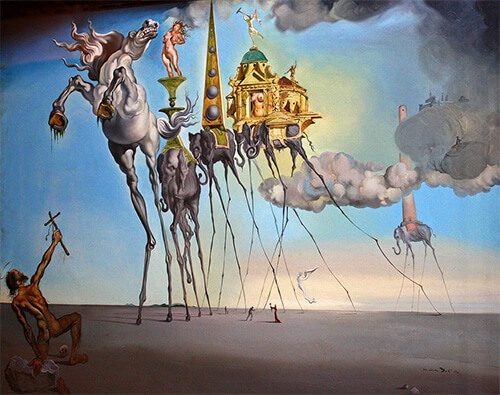
In the 1950s Dalí entered what some have labeled his “Nuclear Mysticism” period. These were years that Dalí was heavily influenced by the new findings of physics and the traditions of Roman Catholicism. Influenced by the recent use of the atomic bomb, Dalí shifted his interest to the cross roads where science and religion meet. His painting Crucifixion (Corpus Hypercubus) is a perfect example of mathematics and religion meeting. In this painting we are presented with the crucifixion of Christ in a 4th dimensional existence. His painting The Sacrament of The Last Supper makes use of a mathematical formula in order to get the precise composition. Another example of Dalí exploring the Christian theme is in his great painting The Temptation of St. Anthony, where the audience witnesses a remarkable Surrealist scene of St. Anthony facing his supernatural temptations. Clearly Dalí saw a link between faith and science, between that grounded in the Earth and that supported by the heavens. His other great paintings in this period were, Galatea of The Spheres, Leda Atomica, and Christ of St. John of The Cross. Often in these works Dalí makes use of his wife Gala as a subject. For him there is a distinct link between Gala and the divine, and between the divine and logical.
After his “Nuclear Mysticism” phase Dalí entered a period where he created vast and large paintings stretched across enormous pieces of canvas. The Discovery of America by Christopher Columbus is 14 feet tall by 9 feet wide. Again, we see Gala as the Virgin Mary and a young Christ like figure bring the ship onto land. This giant painting would set the standard for Dalí’s later period of works. Tuna Fishing, stands at about the same size as The Discovery of America by Christopher Columbus. Though here, in this painting, we see a slight departure from Dalí’s classical style. There are almost holographic elements in this work and stencil like figures. The colors blend in a new way, and it is clear that Dalí is evolving as a painter. One of Dalí’s greatest paintings is The Hallucinogenic Toreador. In t his painting Dalí pays tribute to many things, Classical Greek Art, with his rendition of Venus de Milos his brother (the small boy in the lower right corner), his Spanish up bringing through the imagery of the toreador, and of course his love, Gala.
In 1983 Dalí completed his last painting. By this time he had lost much control in his hands, and he could not paint in the realistic way he once could. The Swallow’s Tail-Series on Catastrophes perhaps can be attributed as a commentary on physics, rather than an homage to it. It is based on the works of Rene Thom, a catastrophe theorist. Again, we see Dalí immense obsession with science and its insights.
Whether it was through his wife Gala, physics, psychology, Spanish motifs, melting clocks, classical art, or ants, Dalí push through with new creative ideas and images way beyond his time. Dali’s paintings explored our inner most dreams and our outer most desires, our wildest fantasies and our deepest fears. He was a psychologist, a surrealist, a mathematician, a religious fanatic, a non-religious fanatic, a Gala devotee, a rebel, a master, an eccentric, a realist, but he was at his core a painter.