Latency is the time it takes a piece of data to travel from your computer to the testing network and back. It is especially important for applications such as gaming, where you want to be as up-to-date as possible. Check latency from 12415 locations worldwide. ICMP PING Traceroute DNS Page load Http Get. Random probes on current map view. On a USB device, poll rate refers to how often the OS will check the USB device for updates. The poll rate together with the scan rate determines the maximum input latency. For example, take the example above were the scan interval is 5ms. If our poll rate is 1000Hz, then the keyboard is polled every 1ms and so the maximal input latency is 1+5=6ms. Check latency from 12415 locations worldwide. ICMP PING Traceroute DNS Page load Http Get. Random probes on current map view. There are no results. There are no results.
Small and portable tool that checks system activity for latency issues, to find out if it's capable to handling audio and video real-time streaming without interruptions
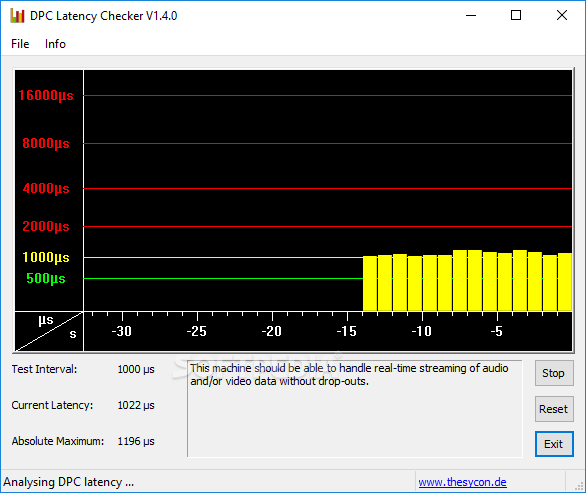
DPC Latency Checker is a tiny and portable application that monitors computer activity and verifies if it is able to handle real-time streaming of audio and video data without interruptions. It does not include configuration parameters.
Since installation is not a prerequisite, you can drop the executable file anywhere on the hard disk and click it to run.
It is also possible to move DPC Latency Checker to a USB flash drive or similar storage unit, in order to use it on any machine with minimum effort.
An important aspect to keep in mind is that the Windows registry does not get new entries, and files are not left behind on the hard disk after program removal.
The interface of DPC Latency Checker is based on a standard window that contains a graph which tracks DPC latency. You can view the test interval, current latency, and absolute maximum value. Aside from stopping the monitoring process, you can reset the numerical values. There are no other options available through this tool. For example, you cannot ask DPC Latency Checker to record activity to file.
The simple application does not put a strain on system resources, as it requires a low amount of CPU and RAM to run properly. No error dialogs were shown in our tests, and the tool did not hang or crash. To conclude, DPC Latency Checker offers a straightforward solution to diagnosing computer latency issues with minimum effort.
Filed under
 DPC Latency Checker was reviewed by Elena Opris
DPC Latency Checker 1.4.0
add to watchlistsend us an update- runs on:
- Windows 10 32/64 bit
Windows 2003
Windows 8 32/64 bit
Windows 7 32/64 bit
Windows Vista 32/64 bit
Windows XP 32/64 bit
Windows 2K - file size:
- 299 KB
- filename:
- dpclat.exe
- main category:
- System
- developer:
- visit homepage
top alternatives FREE
top alternatives PAID
-->Windows Virtual Desktop is globally available. Administrators can create virtual machines (VMs) in any Azure region they want. Connection latency will vary depending on the location of the users and the virtual machines. Windows Virtual Desktop services will continuously roll out to new geographies to improve latency.
The Windows Virtual Desktop Experience Estimator tool can help you determine the best location to optimize the latency of your VMs. We recommend you use the tool every two to three months to make sure the optimal location hasn't changed as Windows Virtual Desktop rolls out to new areas.
Interpreting results from the Windows Virtual Desktop Experience Estimator tool
In Windows Virtual Desktop, latency up to 150 ms shouldn’t impact user experience that doesn't involve rendering or video. Latencies between 150 ms and 200 ms should be fine for text processing. Latency above 200 ms may impact user experience.
In addition, the Windows Virtual Desktop connection depends on the internet connection of the machine the user is using the service from. Users may lose connection or experience input delay in one of the following situations:
- The user doesn't have a stable local internet connection and the latency is over 200 ms.
- The network is saturated or rate-limited.
We recommend you choose VMs locations that are as close to your users as possible. For example, if the user is located in India but the VM is in the United States, there will be latency that will affect the overall user experience.
Azure Front Door
System Latency Checker
Windows Virtual Desktop uses Azure Front Door to redirect the user connection to the nearest Windows Virtual Desktop gateway based on the source IP address. Windows Virtual Desktop will always use the Windows Virtual Desktop gateway that the client chooses.
Next steps
Latency Checker For Windows 10
- To check the best location for optimal latency, see the Windows Virtual Desktop Experience Estimator tool.
- For pricing plans, see Windows Virtual Desktop pricing.
- To get started with your Windows Virtual Desktop deployment, check out our tutorial.